Your best people spend their days on work they've done a hundred times.
Nova takes it off their hands.
Nova is an AI agent that does the work — not just advises on it. It puts the most capable AI models to work inside the workflows your team already runs, does the job alongside your people under their review, and gets more capable and more predictable the more it does it.
recipe: invoice.exceptions · v31 exception: Northwind INV-10422 bills over contract
Line 2 bills 800 filters at $21.00. The signed rate is $18.00 (MSA, Appendix B §4.2), and no rate change is on file. That is $2,400 over. Acme and Brightline match PO, receipt and contract.
INV-10422, queue 2 bills for payment, send the note to Northwind. write · on approval
What Nova is
AI can now do the job. We make it safe to let it.
Nova is an AI agent that works in your real tools the way a new hire would: it reads the invoice in Gmail, checks it against the purchase order in NetSuite, opens the ticket in Jira, and reports back in Slack or Teams.
It runs in your network, behind a broker that holds the credentials so the agent never does. Every call is logged, every action is scoped to the person who asked, egress is deny by default, and spend is metered and capped. Audit, access and cost are handled before the demo, not after the incident.
It learns the job from your team, in the tools they already use, and what it learns becomes a versioned recipe you can read. The tenth invoice runs the same way as the first.
What Nova does
Most of a working day is transport. A task arrives in Slack or a shared inbox. Someone opens one system to get the facts, opens a second to check them against the rule, makes a call that follows the same logic it followed last time, and types the outcome into a third.
The systems do not talk to each other, so a person is the thing carrying the context between them. Nova connects to those same systems and does the carrying.
Two people, the same queue, the same morning. One works by hand. One has Nova.
Eleven a day becomes ninety
The same person, the same queue. Their time per task falls from the thirty-nine minutes it takes to do it to the five it takes to read what Nova did and approve it.
The same check, every time
A proven path runs the same way on the tenth case as on the first, including the one nobody remembered to look at. It does not get tired, busy, or promoted.
Your people stop being the transport
They point Nova at the work and approve what comes back. Judgment and accountability stay with them, which is the part that always needed a person.
How it works
It's one engine, pointed at different work. Nova hardens each kind the same way — only the systems and the output change.
Engineering proves the loop first. The same engine runs in finance, accounting and sales ops, where a small automated win is worth the most. You don't build a new tool for each one.
You never pick what to automate. Whatever your team repeats often enough is what Nova hardens, and the recipes it builds are yours.
Nova runs on Mouline Platform
A control plane that sits in your own network, and every call Nova makes passes through it. That is what makes Nova compliant, secure and cost-effective, and every Nova deployment includes it at no extra cost.
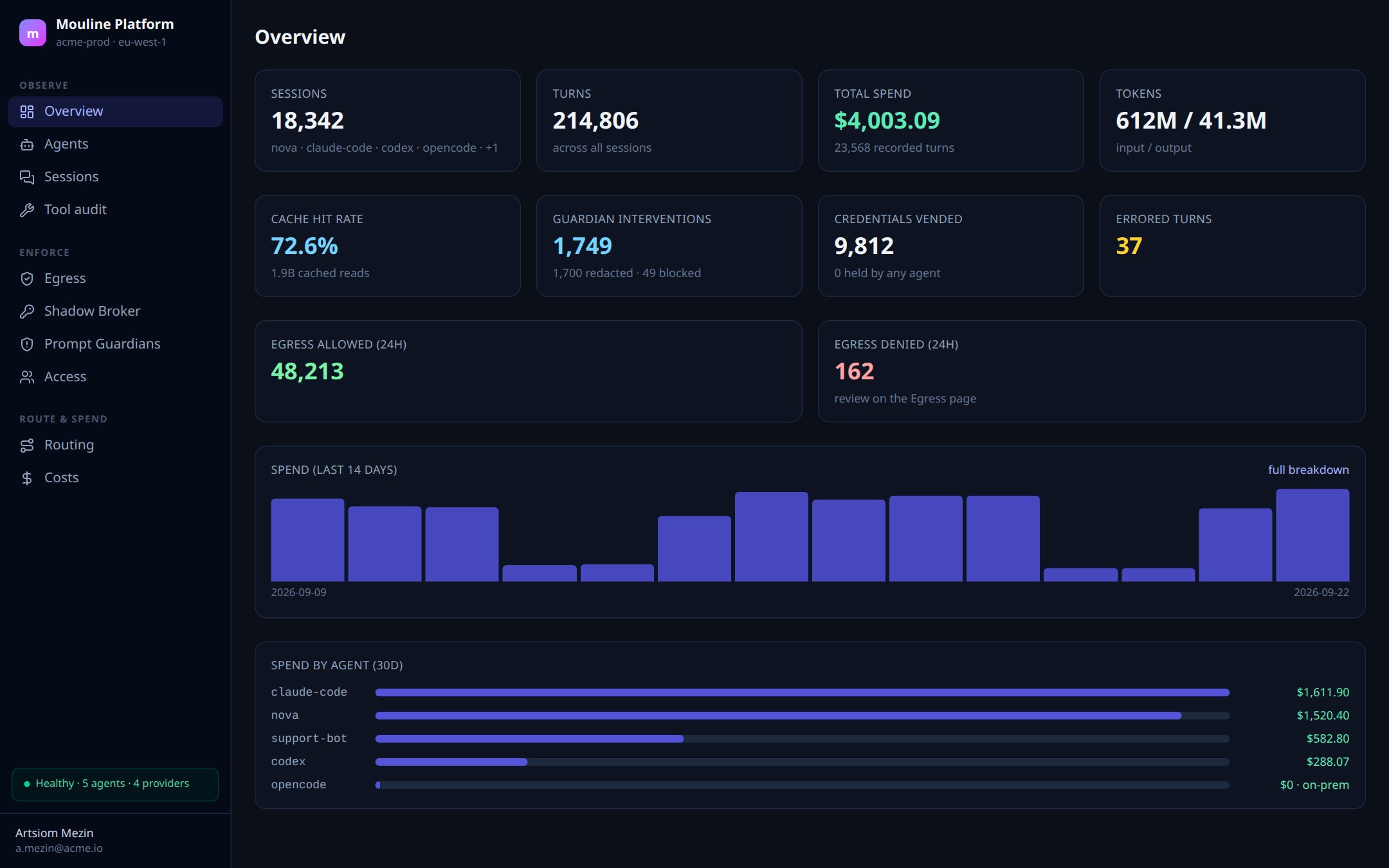
One console, every agent. What Nova did, for which person, against which system, with which data, and what it cost. Single sign-on, role-based access and a full audit trail come with it, and data residency is agreed per deployment.
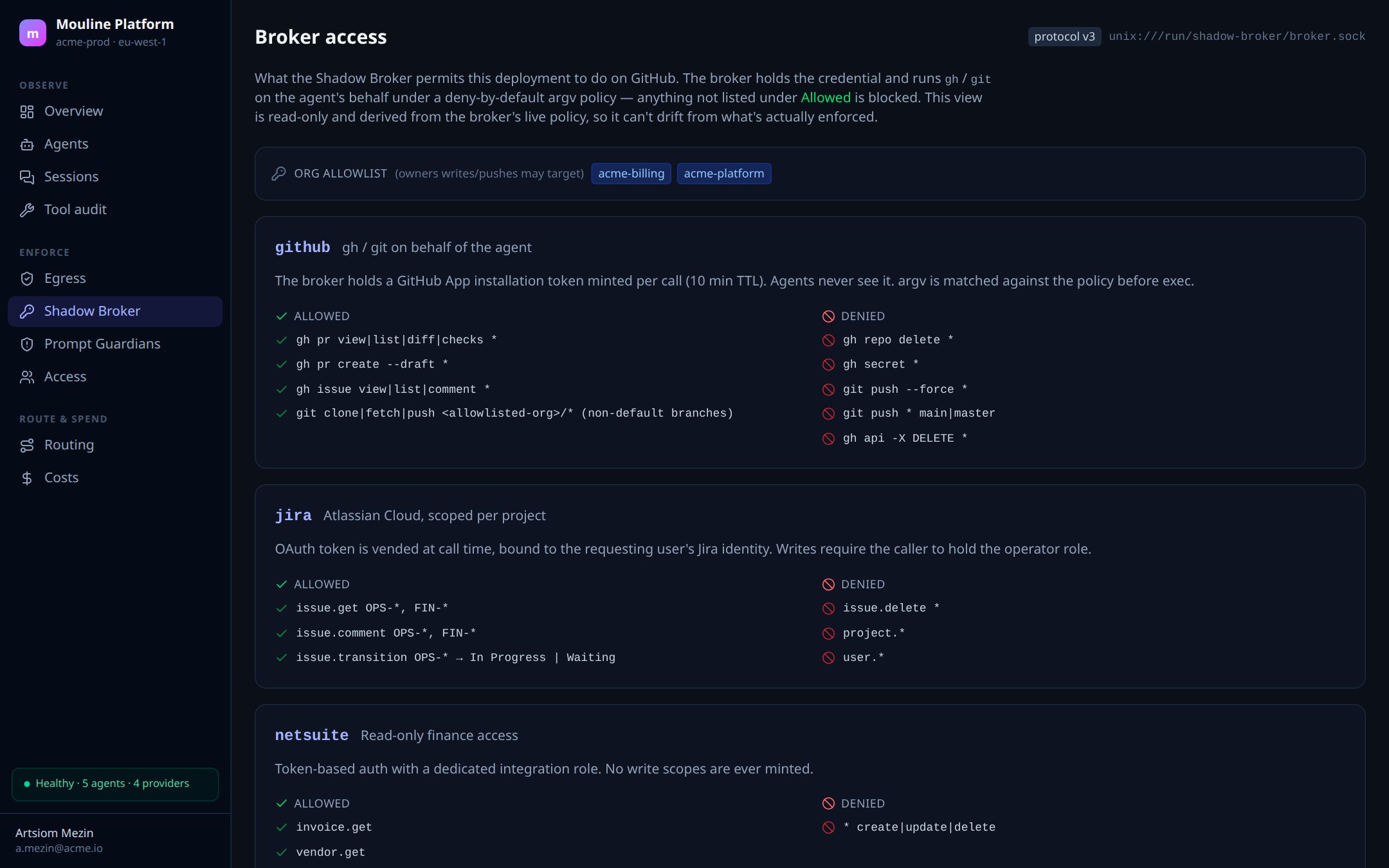
The broker's live policy. A credential broker mints a short-lived, least-privilege token for each call, scoped to the person who asked, so Nova can never reach past what they could already see. Egress control allows only known destinations, and prompt guardians read every prompt before a model does. Anything not explicitly allowed is refused.
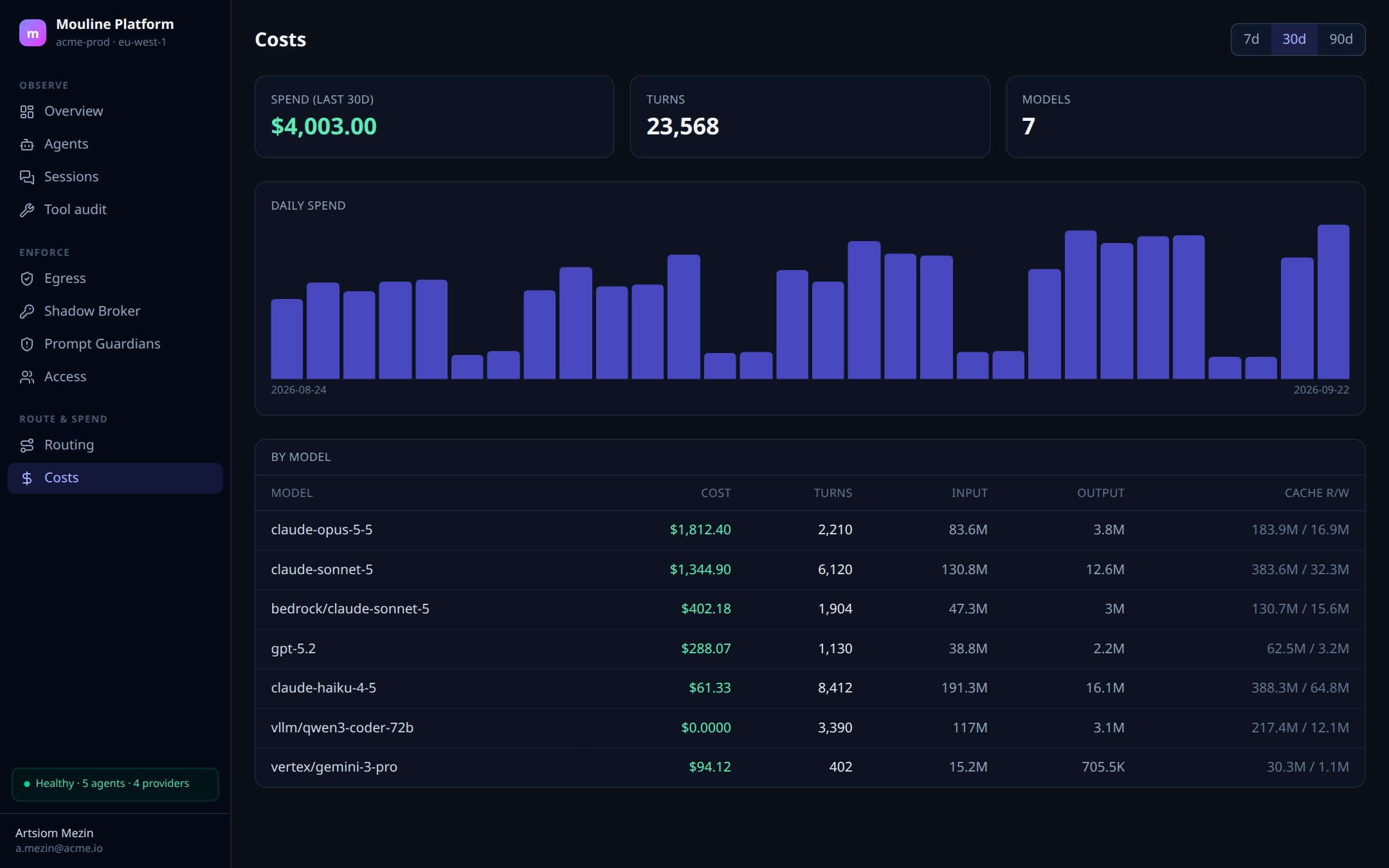
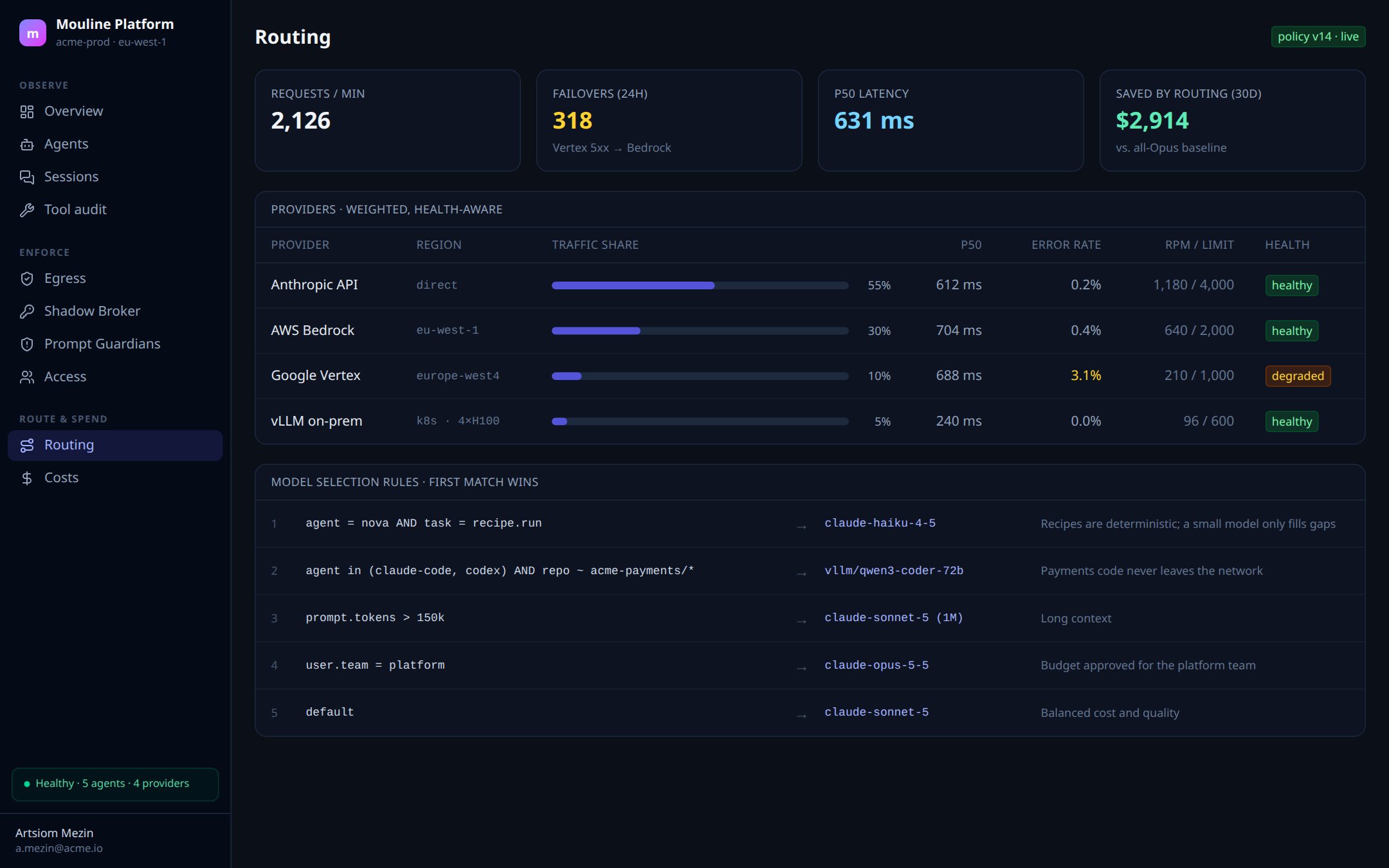
Every call priced. Each AI call is metered and charged to a team, and you set the limits, so there are no surprise bills. Fixed recipe steps go to a cheap model and the expensive ones are kept for work that needs them.
Four providers, one of them yours. Run Nova on OpenAI, Anthropic, or open-source models you host yourself, and keep the most sensitive work on a model that never leaves your environment. Your data is never pooled with another customer, never shared with an AI provider, and never used to train anyone's models.
The same plane fronts the coding agents your engineers already run: Claude Code, Codex, Opencode. One checkpoint covers every agent in your network, Nova included. It is also sold on its own, to teams who want the checkpoint without the agent.
How we deploy
Three steps — the infrastructure is ready in about a week, mostly on us.
Integrations
You name the stack — your dev, ops, field, finance and data tools. We map it.
Access
Each system gets the access its work needs: read-only where Nova only looks, read/write where she's expected to act — and even then she acts by proposal, a pull request or a draft for a person to approve.
Deploy
We provision a dedicated, fully isolated environment alongside your team and ship Nova into it. No shared infrastructure, no co-tenancy.
Standing up the infrastructure takes about a week. Connecting your systems can take longer — that part moves at the pace your side can grant access — but Nova starts working the moment the first integration is live.
How we engage
We ship it, install it with your team, and keep it hardening. A hybrid model, built so you see value before you pay to keep it.
Standard
The full platform for one team: Nova runs your workflows inside the tools you already use and keeps your recipes hardening as your team works with it.
Business
Everything in Standard, plus product support: bug fixes, new integrations as your stack changes, and help standing up new use cases as the engine expands across your recurring work.
Enterprise
Multiple teams, larger footprints, security review and procurement on your terms. Call us and we will shape the deployment around your environment.
No value, no fee. Every plan starts with a one-time $1,000 implementation: a short, hands-on project run with your team that deploys Nova into a dedicated, fully isolated environment, wires up integrations, and stands up your first workflow. If it doesn't prove real value during the engagement, you opt out and the monthly fee never kicks in.
Who it's for
Nova is for you if…
- You have real, repeatable operational work — and a team whose best hours are spent on it
- The more integrations, data sources, and hand-run processes you have, the more Nova pays back
- You want the work done in the tools you already use, not another app to open
- It starts where your repetitive work is densest and expands from there
Nova is not for…
- Companies still finding product-market fit
- Teams with only a handful of recurring cases a week
- Anyone who would rather buy a dashboard than change how work gets done
Who builds it
We're the two founders — UK/Canada-based technical leaders with deep experience in AI, platform engineering, and SRE. We have designed and operated enterprise AI systems at Deutsche Bank, Behavox, SAP, Mail.Ru, and Lightspeed — production environments consuming billions of LLM tokens a month and orchestrating hundreds of independent agents across customer support, incident management, and the SDLC.


Point Nova at the work your team repeats.
Nova deploys in about a week. The first step is a short call to map your stack and confirm access. From there, the agent is working on real cases within days.
Built by engineers who've run hundreds of production agents. A person approves anything consequential.